What is Market Pricing?
Market pricing, also referred to as market-based pricing, is a strategy for setting prices based on what the current market prices are for similar products or services. The anchor is external (e.g., competitors and market conditions) rather than internal costs or customer perceptions of value.
Market-based pricing gives businesses the opportunity to set higher prices initially before matching market prices to stay competitive while still growing return on investment. It isn’t without its challenges. The most common challenge of market pricing is determining the right price.
If your competitors have misjudged the market? Then your replication of price won’t be accurate. This could lead to further problems for you, including not being able to build your own customer base.
Market pricing is one of the most common approaches in B2B, especially in markets and industries where products are not very different from each other. When buyers can easily compare prices across providers, it’s important for businesses to stay within the same price range as their competitors.
The prices in the market are only as good as the signals you are getting. If your competitors have set their prices too high, mimicking them will put you in a similar bind. Those mistakes can be costly in B2B settings where margins are thin.
You should also know how market pricing is different from other common pricing methods, such as cost-plus pricing, value-based pricing, and dynamic pricing. Each one starts from a different point of reference, and knowing the difference helps you use market pricing to your advantage.
Market Pricing Factors to Consider
Aside from the market price itself, there are several factors to consider when implementing a market-based pricing strategy:
Production costs
If you’re selling a physical product, this includes the cost of materials, manufacturing costs, shipping, packaging, and employee hours. If you’re selling a service, it includes any equipment and/or supplies, employee hours, and operational costs.
Business expenses
You can’t simply charge what it costs to produce a product; you also need to factor in enough money to support your overhead (building costs, admin costs, etc.)
Customer demand vs. market saturation
If there’s a high demand for your service but very few people offering it in your area, you can charge more. Conversely, if there is a low demand for your service or if you have a lot of competitors, you may have to adjust your price downwards.
Customers’ willingness to pay
A product’s value is heavily influenced by the customers’ willingness to pay. That perceived value sets a practical limit for pricing that’s based on factors like economic conditions, available alternatives, and how well a product solves problems. Last year’s buyers who stretched their budget for your solution may have three alternative options to choose from this year.
Industry average pricing
If you’re in an established industry that has generally set market prices, you will probably price your product accordingly. A price that’s too low can make customers equate your offering with an inferior product; a price that’s inexplicably high may turn customers away.
Competitors’ products and prices
If you have several serious competitors and their market prices are all similar, yours will probably be similar too – unless you’re chasing either the budget or prestige markets and want to use price as a key differentiator.
Product lifecycle
Products that have a short life (like smartphones, tablets, and other tech devices) tend to be priced lower the longer they are on the market.
Market Pricing vs. Other Pricing Strategies
Every pricing strategy starts from different inputs. In contrast to other common approaches, here’s a look at market pricing versus:
- Cost-plus pricing: This strategy bases pricing on your internal costs and adds a profit margin on top. Market pricing takes more into account external competition and consumer behavior.
- Value-based pricing: Value-based pricing sets the price based on what customers think the product is worth. Market pricing sets prices based on what other companies charge.
- Dynamic pricing: Responsive to market variables, dynamic pricing changes prices frequently based on demand, inventory, or consumer trends. Market-based pricing is more stable and driven by natural fluctuations in the market landscape.
- Penetration pricing: Penetration pricing means lowering prices deliberately to quickly gain market share. Market pricing tries to stay within the range of competitors, not below it.
- Price skimming: When launching high-demand or premium products with little competition, price skimming starts with a high price and gradually lowers, or “skims”, it over time. Market pricing does not follow a predetermined price arc, as it responds to where the market is at any given moment.
- Prestige pricing: This strategy sets prices intentionally high to signal high quality or exclusivity, while market pricing prioritizes competitive alignment over brand perception.
Positioning Yourself in the Market
Understanding how you position yourself in the market will affect the price of your product and it can also help you develop a stable pricing strategy. Market pricing and market positioning often intersect in these areas:
The age of the business
If you’re just starting out and you’re looking to build up your client base, you may want to start with a lower price and then increase your price as you become more established.
Capital and cash flow
If you have a significant amount of cash in reserve, you don’t have to worry as much about covering operating and development costs (at least initially). In this case, you can start out with a higher price than you might otherwise have done; you don’t need to win clients in the same short timeframe. You can afford to be a bit more patient.
How you differentiate yourself from other competitors
Although price is often the biggest factor influencing purchase decisions, there are other factors involved – hence why you see brands in the same market with very different unique selling points. If you offer something that none of your competitors have, you can use that to attract a market share. And you won’t necessarily have to rely on low introductory rates to gain traction.
In each of the above factors, the average market price is not necessarily the right choice for that particular business. As a strategy, market-based pricing is dependent on industry, customer, and company-specific information – it’s important to take all of that data into consideration.
When Market Pricing Works Best
Pricing based on market dynamics is seldom a universally applicable scenario. Market pricing is most effective in a few different types of environments, such as when there’s clarity in the competitive landscape and when there are viable options for buyers.
- Competitive environments: The more competitors offering a similar solution, the more likely buyers are to compare prices. To remain in the discussion, you need to be within a competitive price range – whether that’s by design or necessity.
- Products with low differentiation: If your product has little meaningful difference from comparable products, buyers will make purchasing decisions based on price. Market pricing keeps you competitive while preventing you from overreaching your margins.
- High price transparency: In industries where pricing is readily available to the public or easily researched, consumers already have a general idea of the product’s going price. Market pricing gives buyers what they expect to see.
- Commodities/standardized products: When products are virtually identical among providers, the market typically sets the price. Fighting against this baseline involves headwinds when differentiation is minimal.
When Market Pricing Falls Short
The markets are not always rational, so the strategy of anchoring pricing on competitors can have potential risks and complications.
A major pitfall of this strategy is margin erosion. The reason is simple; as the cost structure of a company is ignored while comparing with the cost structure of its competitors, small and gradual pricing concessions (which may seem insignificant) will continue to compound, and eventually it will be difficult to close the gap between price and profit.
Another hazard of this strategy is the destructive nature of price wars. A competitor can lower their price, and if you react by lowering yours, then they will lower theirs again, and so on and so forth until no one is making a profit. In addition to eroding margins, price wars damage the entire market’s profitability over time, not just the competing loser.
There are other, less obvious risks when relying solely on market-based pricing. When using price as the primary means of differentiating your products or services, it can become increasingly difficult to articulate and convey how your product/service is truly different from others. As price becomes the primary method of differentiation, customer retention will become more tenuous, and customers will be more expensive to acquire.
Lastly, there is a subtle trap of reactive pricing. Just because a competitor lowers their price does not mean it is a sign to chase after them. At times, competitors will lower their prices due to internal pressures, such as a cost increase, an inventory issue, or a need to meet a quarterly target, rather than a true shift in the market supporting the new price.
Market Pricing in B2B Contexts
In B2B, the best practices on how to set prices differ from those in consumer markets. The repercussions are more impactful, the buying cycles are longer, and prices vary by customer, contract, and channel. This is what happens in some of the most common B2B settings.
Manufacturing
Manufacturers often operate in markets where raw material prices fluctuate, and it’s easy to see what their competitors are shifting. Market pricing helps them stay competitive on finished goods, but the hard part is ensuring price changes happen in sync with input cost changes. Margins suffer when those two things don’t line up.
Distribution
Distributors usually have low profit margins and high sales volumes, so it’s very important to keep prices in line with the competition. Even a slight price difference can quickly send a buyer to a different supplier. At the same time, it can be hard for distributors with large SKU catalogs to keep track of market prices at scale. This is where pricing software comes in.
Industrial Goods
Products are typically similar across industrial markets, allowing buyers to compare prices directly across different sellers. While market pricing is a logical approach, pricing strategists should factor in lead times, level of service, and the value of the relationship, which aren’t directly related to competitors’ list prices.
Complex channel pricing environments
There are many ways for B2B companies to sell their products, including direct, reseller, distributor, and online sales. Each of these has its own pricing expectations. One of the most challenging pricing problems for businesses is maintaining market alignment across all those channels without causing conflicts between them. B2B pricing strategies have to be flexible enough to reflect how each channel works while still being consistent enough to protect margins.
High-volume, contract-based selling
Prices are often negotiated rather than listed in enterprise B2B. Market pricing remains important here because it sets the lowest price buyers expect to pay. Companies that know where the market stands can negotiate from a stronger position rather than give in on price because they don’t know what to do.
Executional Challenges When Pricing at Scale
The easy part is determining the cost in the market. However, things get complicated when you have deploy this exercise frequently across large, complex inventories. Some of the most common executional problems are:
- Managing expansive price lists: Companies that have hundreds or thousands of SKUs can find it difficult to keep prices aligned with market conditions. Without the automated software for price management, pricing strategies become stale, and competitive gaps appear without anyone noticing if you don’t have the right tools.
- Tracking real market signals: Good market data is essential for accurate pricing. Many businesses rely on outdated or incomplete information about their competitors, so their “market-based” prices are really just educated guesses.
- Balancing competitiveness with profitability: Matching the market keeps you competitive, but it doesn’t always protect your margins. It is easy to win deals that lose money without knowing how price changes affect profits at the product or customer level.
- Internal alignment: Sales teams need to close deals. Finance teams want to protect their margins. Pricing teams are trying to keep a logical plan that targets a happy medium. Without shared data and clear rules, competing priorities lead to inconsistent outcomes across the business.
- Inconsistent pricing across channels: When the same product is sold through multiple channels at different prices, it becomes difficult to keep the market aligned. When things are inconsistent, it can cause problems across channels and make partners lose trust.
- How fast prices change: Markets can change unexpectedly. When you have to wait for manual approval processes to make a price change, you often react too late. There is a real competitive weakness in the time it takes for your prices to reflect market changes.
- Managing discounts: Even a well-planned price list can be undermined by reckless discounting in the field. Without guardrails, negotiated prices can move far away from where they were meant to be in the market, and it is hard to change those patterns.
Market Pricing: The Good and The Bad
An HBR survey of B2B companies found that 85% of respondents felt their pricing decisions and strategies could improve. The lesson to draw from this is that your competitors may very well be making pricing mistakes, and all pricing strategies have their weak points. That said, what are the positives and negatives of market pricing?
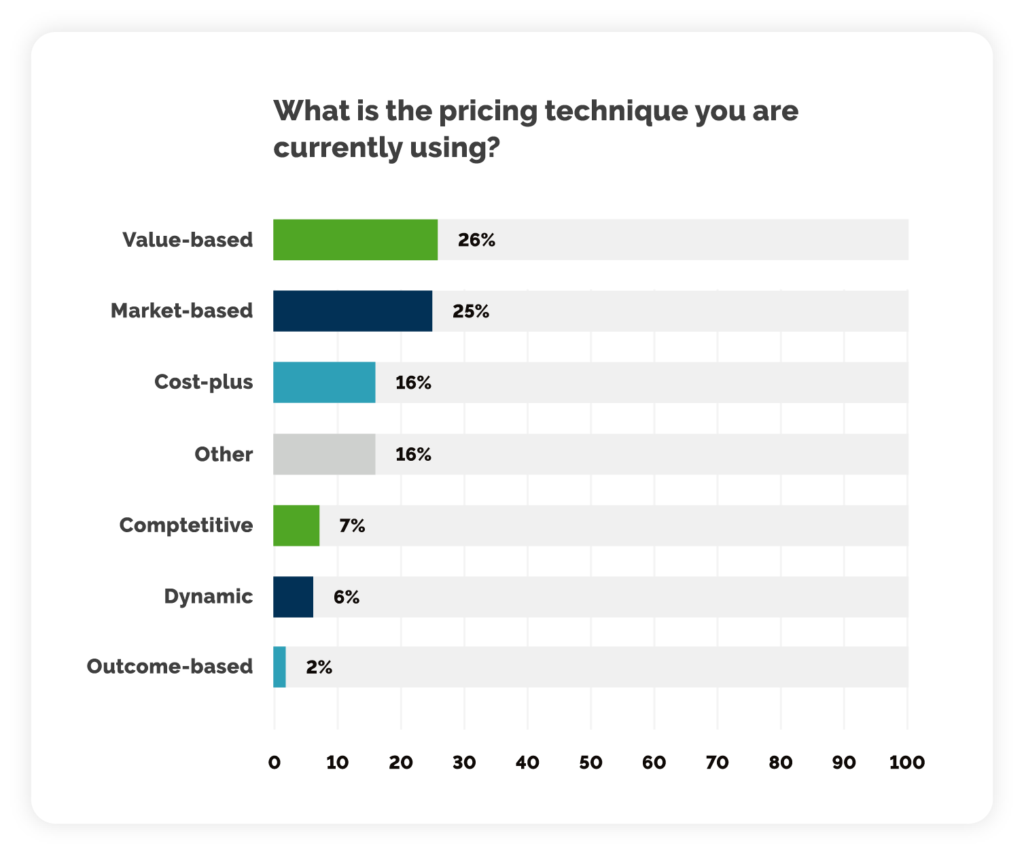
- If you’re dealing with an established industry, market pricing usually provides accurate insight into what customers are willing to pay. If you charge a lower price than your competitors but provide similar quality, you have a good chance of attracting some of their customers. If you have something special to offer, you could justify a higher price point.
- An important thing to keep in mind is that market-based pricing is primarily concerned with the competition. To some extent, we could say that it’s focused on customers – but only to the extent that it considers what customers are willing to pay and what features they expect. As such, it tends to leave customer experience out of the equation when there are customer insight-based pricing solutions available that prioritize the customer.
- Another pitfall of market pricing can be its dependency on your competitors’ strategies. If their strategies fall short, yours may very well do so too. Even if their pricing structure has worked in the past, there’s no guarantee that it will work now or in the future.
There’s no doubt that market pricing has its uses. At the very least, it makes a great benchmark and a good starting point for your research. But there’s a lot more to a successful pricing strategy, including price optimization.
How Pricing Software Supports Market Pricing
At scale, market pricing is a data and workflow problem as much as it is a strategic problem. Companies that execute it well have systems that provide them with current visibility into what is happening in their markets. A few primary ways in which modern pricing software addresses these kinds of complexities include:
- Market benchmarking tools enable pricing teams to continuously assess how their company’s prices compare to those of their competitors (and other relevant benchmarks).
- Price governance capabilities establish boundaries (such as ranges) for pricing discounts and rebate programs granted by sales representatives or other field personnel, thereby providing some degree of defensibility for the company’s pricing strategy.
- Automation enables large price lists to be updated and managed in a timely manner without requiring manually-driven processes.
Vendavo was created to address the complexities associated with large-scale pricing. Vendavo pricing solutions help B2B organizations integrate the alignment of a competitive pricing strategy with profitability, which provides sales, finance, and pricing teams a common foundation upon which to collaborate.
If your organization needs help with smart, data-backed pricing, dynamic pricing, revenue growth, or other areas, Vendavo is here to help.
FAQs About Market Pricing
What is market pricing in simple terms?
Market pricing is essentially setting a company’s prices by considering how much its competitors are charging for similar products and/or services. Instead of using internal costs or perceived customer value, the company uses competition and market-based variables as the primary anchor point for pricing.
Is market pricing good for B2B companies?
Market pricing can work well in competitive B2B markets with many suppliers and fairly standardized products. A big part of making this type of pricing model successful for B2B companies is understanding the market and putting profitability boundaries around the pricing strategy.
How is market pricing different from value-based pricing?
Value-based pricing looks at what your customers perceive as the value of your product. Market pricing examines what your competitors are charging for your product. When you have a product that is very difficult to differentiate, value-based pricing will generally allow you to capture more margin. However, when you have a product that is easy to differentiate market pricing is going to help you compete.
Does market pricing reduce profit margins?
It can. If you do not keep track of your internal costs when anchoring your pricing to your competitors’, you will slowly erode away your margins. However, keeping your pricing discipline will allow you to strike a balance between maintaining profitability and competing effectively in the marketplace.
Can market pricing be automated?
Yes. There are several types of pricing software that will allow you to monitor your competitors’ pricing models, let you know when they have changed their pricing model, and allow you to update your pricing model across all of your products and/or services automatically. Pricing software is especially useful when you have an expansive inventory that makes it impractical to manually monitor your competitors’ pricing models.
Is market pricing the same as competitive pricing?
While market pricing and competitive pricing are often used interchangeably, technically speaking, competitive pricing is a subset of market pricing. Market pricing includes competitive pricing, but it also takes into consideration industry standards and consumer purchasing behaviors.
When should companies use market pricing?
Market pricing works best in highly competitive markets, commodity or standardized product categories, and environments where buyers can easily compare prices. It is less effective when your product has strong differentiation that justifies a premium.
How can pricing software support market pricing?
The combination of market intelligence, automation, and governance provided by pricing software will enable companies to implement market pricing strategies at scale. By providing pricing teams with real-time access to information about competitors’ pricing, automating processes such as updating price lists, and enabling them to ensure that pricing strategies are profitable while still being competitive, pricing software can significantly improve the effectiveness of a company’s pricing strategy.